Robert Indiana kept a series of illustrated journals during the late 1950s and 1960s, in which he discusses the development of his work as well as his daily life on Coenties Slip.
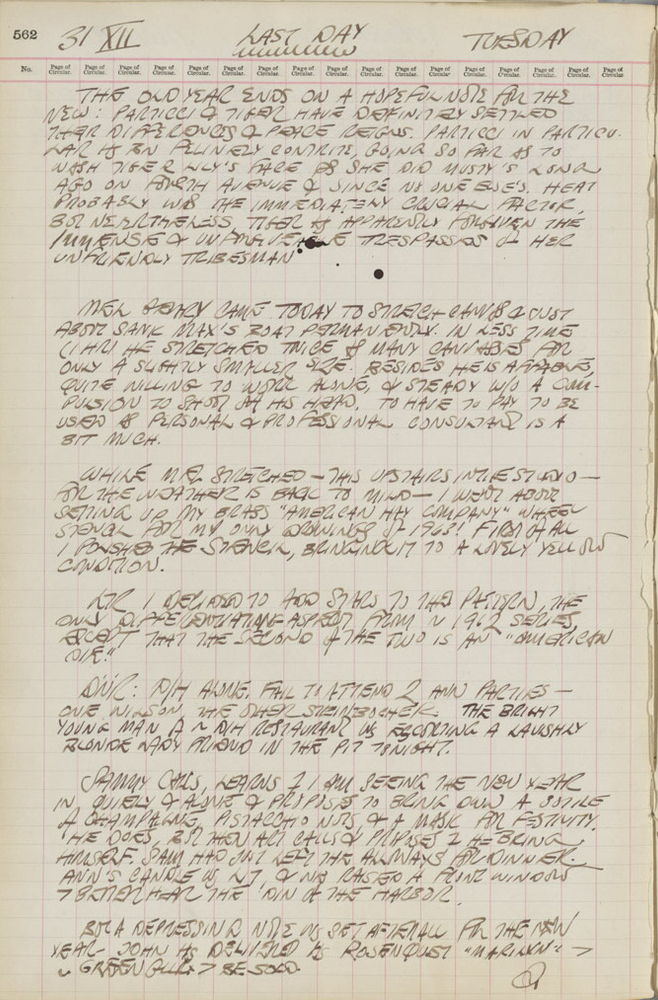
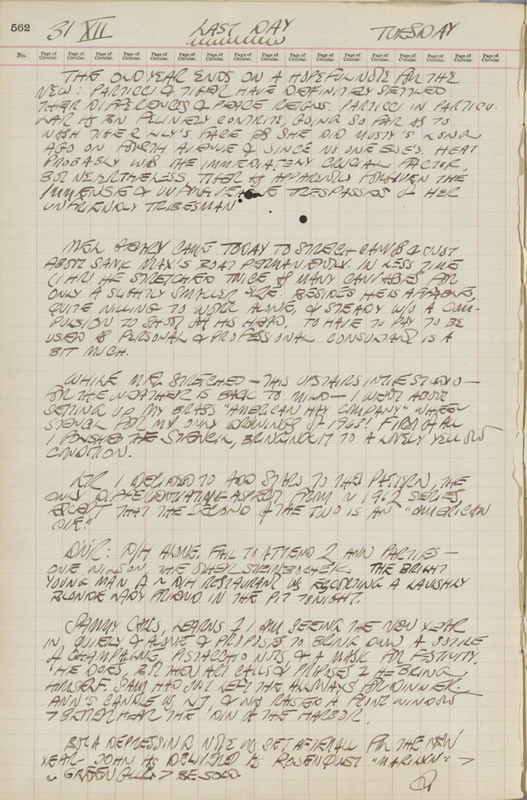
Indiana begins his journal entry for December 31, 1963, noting: "the old year ends on a hopeful note for the new: Particci and Tiger [his two cats] have definitely settled their differences and peace reigns. He records that artist Mel Geary came over to stretch canvas for him and "just about sank Max's [who had been helping him] boat permanently," as he stretched twice as many canvases in less time. He adds that Geary was affable, willing to work alone, and steady, "without a compulsion to shoot off his head, to have to pay to be used as a personal and professional consultant is a bit much."
Indiana writes that while Geary stretched in the studio he set up his American Hay Company stencil for his only drawings of 1963. He first polished the stencil, and later decided to add stars the the pattern, "the only differentiating aspect from the 1962 series, except that the second of the two is an 'American Die'."
He records having dinner alone at the D/H (the Seamen's Church Institute, often referred to as the Doghouse), failing to attend two parties, and that his friend Sammy, upon learning that Indiana was planning on "seeing the New Year in quietly and alone . . . proposed to bring down a bottle of champagne, pistachio nuts, and a mask for festivity." He did, and then Indiana received a call from Art (clinical psychologist and art collector Arthur Carr), who proposed coming over.
Indiana ends the entry writing that "a depressing note was set after all for the New Year," as John (Kloss, a fashion designer and his former partner) had delivered his James Rosenquist painting "Marilyn" (Marilyn Monroe No. 2, retitled Fast Pain Relief) to the Green Gallery to be sold.