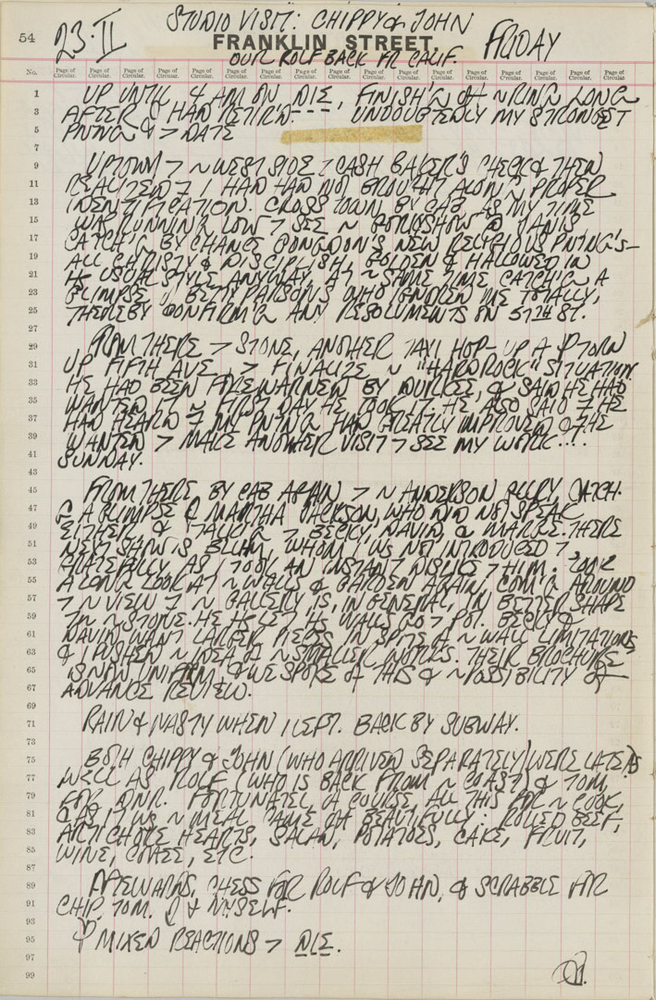
Robert Indiana kept a series of illustrated journals during the late 1950s and 1960s, in which he discusses the development of his work as well as his daily life on Coenties Slip.
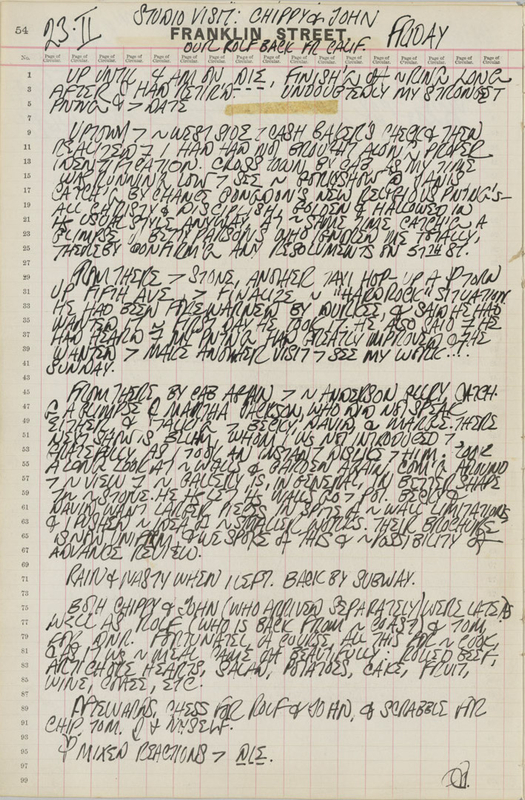
In his journal entry for February 23, 1962, Indiana writes that he was up until four in the morning working on Die (of the diptych Eat/Die), finishing up the ring long after J. (his partner, fashion designer John Kloss) had retired. He declares it "undoubtedly my strongest painting [to] date."
Indiana then describes his day outside of the studio, which began with him heading uptown to cash a check from collector Richard Brown Baker, and then visiting various art galleries. His first stop was the Gorky show (Paintings by Arshile Gorky from 1929 to 1948) at the Sidney Janis Gallery, followed by the William Congdon show at Betty Parson's Gallery. Of the latter's "new religious paintings" he writes "all Christy and disciplish, golden and hallowed in his usual style. Anyway, at [the] same time catching a glimpse of Betty Parsons who ignored me totally."
He records that his next stop was to see Allan Stone "to finalize the Hardrock situation." Indiana writes that Stone "had been forewarned by [Stephen] Durkee, and said he had wanted it [the] very first day he took it," and that "he had heard [that] my painting had greatly improved and [that] he wanted [to] make another visit [to] see my work." After seeing Stone he notes heading to the Martha Jackson Gallery, where he "took a long look at [the] walls and garden again, coming around [to] [the] view [that] [the] gallery is, in general, in better shape than the Stone. He has let his walls go to pot." He notes that David and Becky (Jackson's son and daughter-in-law) "want larger pieces in spite of [the] wall limitations and I pushed [the] idea of [the] smaller works. Their brochure is not uniform, and we spoke of this and [the] possibility of advance review."
Indiana then records heading home by subway, and having guests over that evening. He writes that the reactions to Die were mixed.