Robert Indiana kept a series of illustrated journals during the late 1950s and 1960s, in which he discusses the development of his work as well as his daily life on Coenties Slip.
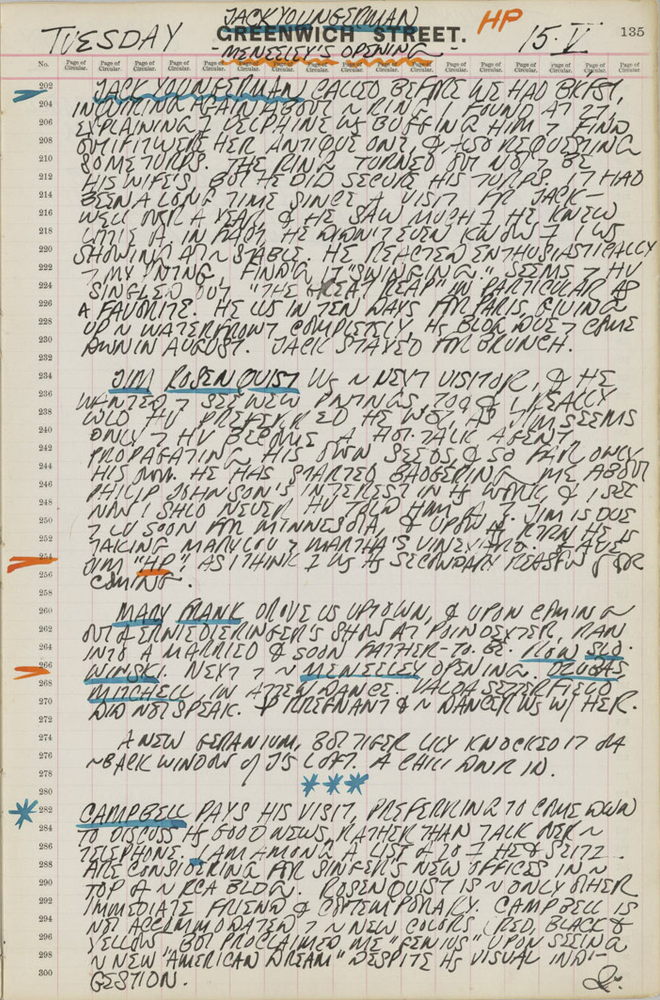
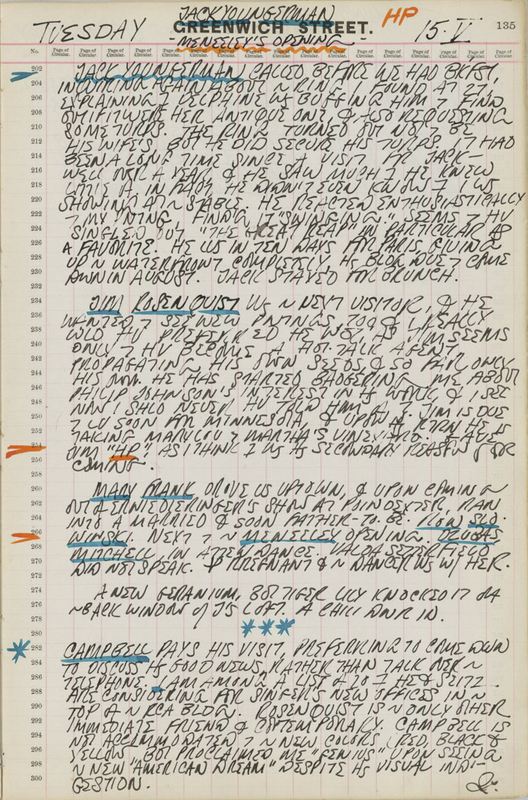
In his journal entry for May 15, 1962, Indiana describes a visit from Jack Youngerman, who had not visited in over a year, noting that "he saw much [that] he knew little of. In fact, he didn't even know [that] I was showing at [the] Stable. He reacted enthusiastically [to] my painting, finding it 'swinging.' Seems [to] have singled out The Great Reap in particular as a favorite."
His next visitor was James Rosenquist, who wanted to see some new paintings. Indiana writes that he "really would have preferred he not, as Jim seems only [to] have become a hot-talk agent propagating his own seeds, and so far only his own. He started badgering me aboubt Philip Johnson's interest in his work, and I see now I should never have told him of [this]."
He also notes that he gave Rosenquist the painting HP, which he thought "was his secondary reason for coming."
Indiana then records being driven uptown by artist Mary Frank, and seeing various gallery shows, starting with the Ernest Dieringer exhibition at Poindexter Gallery, where he ran into "married and soon father-to-be" Ron Slowinski. This was followed by the Edward Meneeley opening, where he saw artists Friedel Dzubas and Fred Mitchell, and dancer Valda Setterfield, who "did not speak."
The last paragraph of the entry describes a visit from Museum of Modern Art curator Campbell Wylly, who reported that Indiana was among a list of twenty artists that he and William Seitz were considering for Singer's new offices in the top of the RCA building. He writes that Rosenquist was the "only other immediate friend and contemporary," and that Cambell was "not accommodated [to] [the] new colors, red, black and yellow, but proclaimed [him] 'genius' upon seeing the new American Dream [The Black Diamond American Dream #2], despite his visual indigestion."