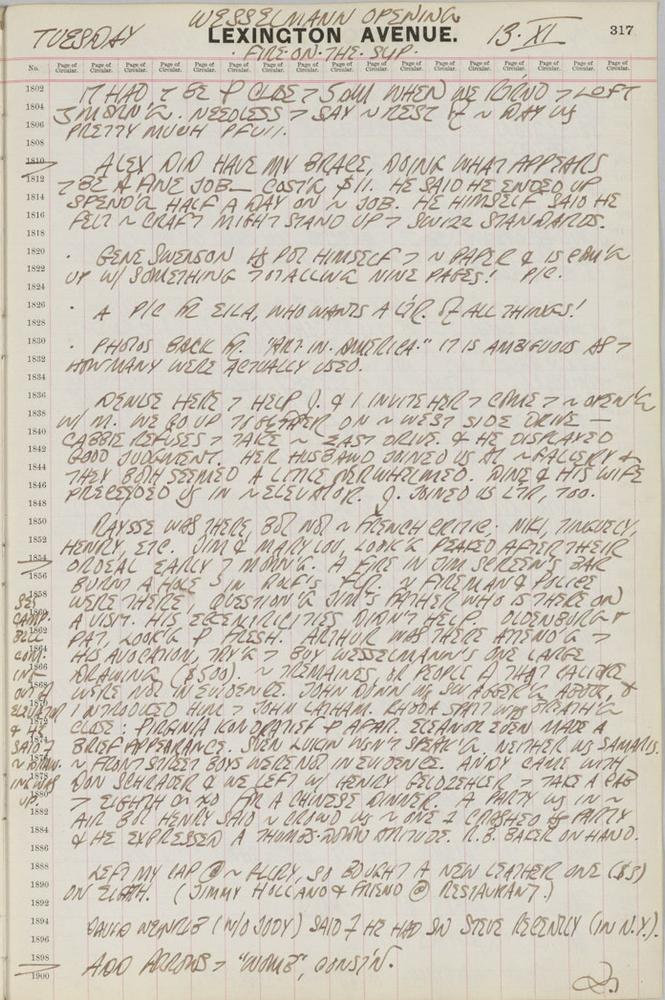
Robert Indiana kept a series of illustrated journals during the late 1950s and 1960s, in which he discusses the development of his work as well as his daily life on Coenties Slip.
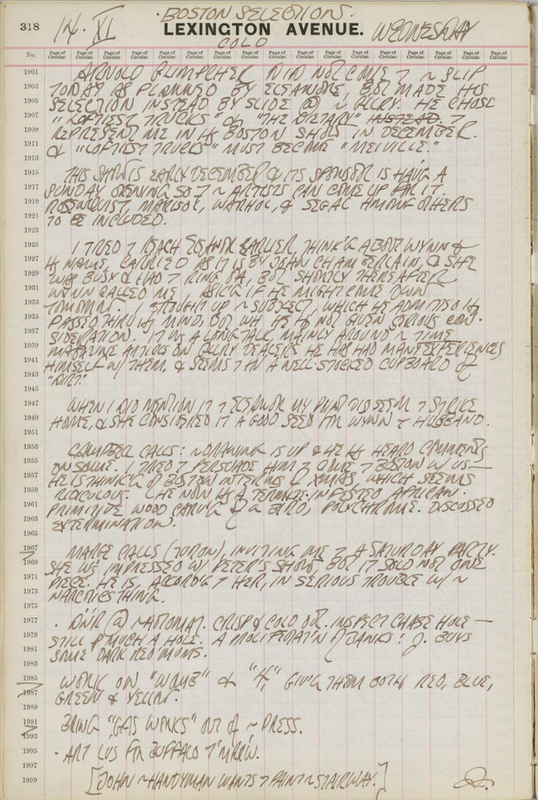
In his journal entry for November 14, 1962, Indiana records that Arnold Glimcher (founder of Pace Gallery) did not come to his studio as planned, but instead chose works for his December show (Stock Up for the Holidays: An Anthology of Pop Art, Pace Gallery, Boston, December 10, 1962–January 2, 1963) by slide at Stable Gallery. He notes that Glimcher chose Loftiest Trucks and The Dietary (ultimately three different Indiana paintings were included in the show), and that "'Loftiest Trucks' must become 'Melville' [the work's current title]."' Regarding the exhibition Indiana writes: "The show is early December and its sponsor is having a Sunday opening [so] [that] the artists can come up for it. Rosenquist, Marisol, Warhol, and Segal among others to be included."
Indiana also records a call with the artist Wynn Chamberlain, noting that he shares the same last name as John Chamberlain, and that Wynn had many experiences with gallery dealers, "and seems[ to] have a well stocked cupboard of 'dirt.'" He then details a call from Museum of Modern Art curator Campell Wylly, who informed him that his drawing, The American Hay Company, was on display in the museum's current Penthouse Exhibition.
Indiana discusses working on three more pieces after dinner, writing that he gave Womb and 4 (Four) "red, blue, green and yellow," and that he brought Gas Works (The American Gas Works) "out of [the] press."