Robert Indiana kept a series of illustrated journals during the late 1950s and 1960s, in which he discusses the development of his work as well as his daily life on Coenties Slip.
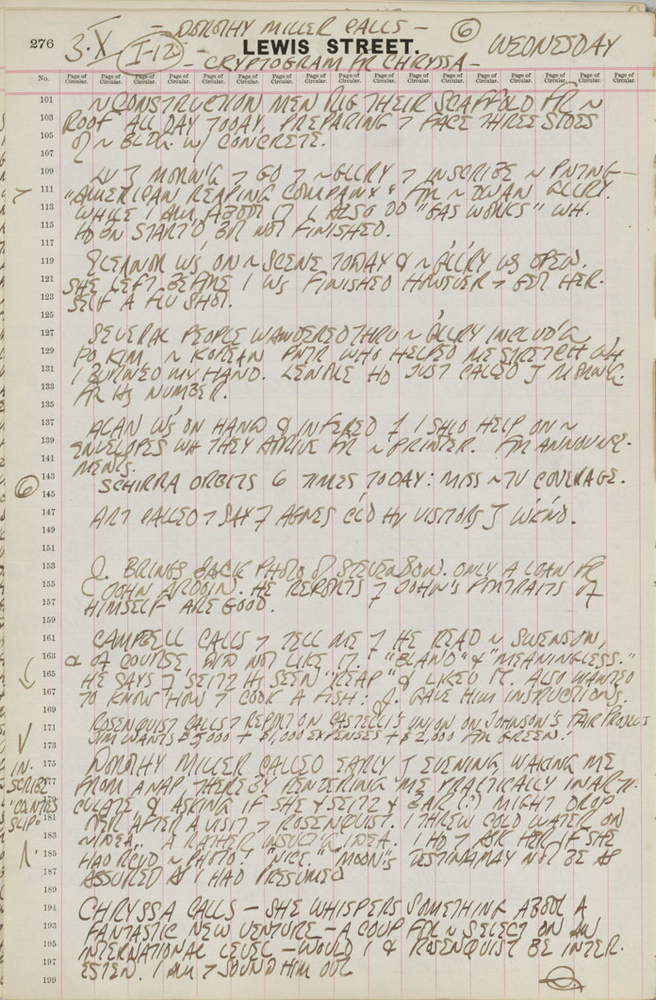
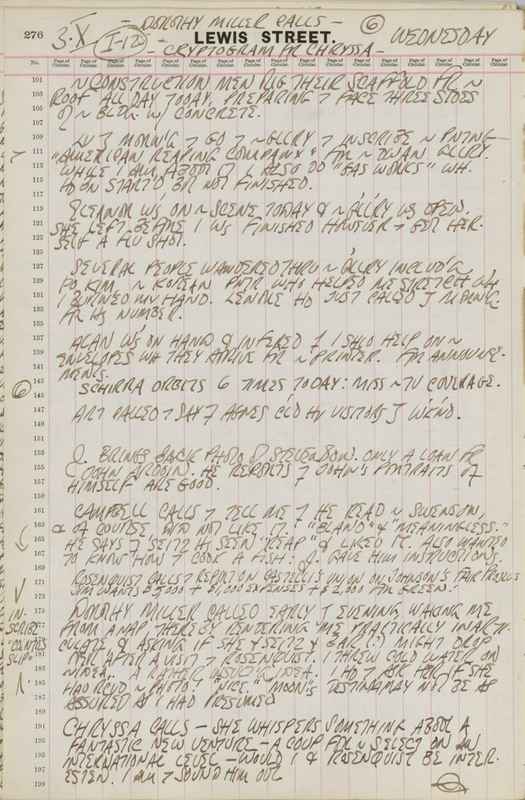
In his journal entry for October 3, 1962, Indiana records leaving in the morning to go to Stable Gallery to inscribe The American Reaping Company for Dwan Gallery (where it would be included in the exhibition My Country ‘Tis of Thee). He also notes inscribing The American Gas Works, which he had started but not finished, and a note on the side of the journal page indicates that he inscribed Coenties Slip.
Indiana writes that the gallery was open, and that several people wandered through, including artist Po Kim, who had helped him stretch canvas when he burned his hand. He notes that Alan Groh, Stable Gallery's director, inferred that he should help with the envelopes for his exhibition announcements (for his solo show opening later that month).
Indiana also records numerous phone calls, first from Art (clinical psychologist and art collector Arthur Carr), who told him that Agnes Martin (who was at the New York Psychiatric Institute) would be able to have visitors. He then mentions a call from Museum of Modern Art Curator Campbell Wylly, who had seen Gene Swenson's article in ARTnews and called it "'bland' and 'meaningless'." (This is either a reference to the preview of Indiana's show in the October 1962 issue, or to the article "The New American ‘Sign Painters’," published in the September 1962 issue.) Wylly also reported that Bill Seitz (a curator at the Museum of Modern Art) had seen and liked Reap (The American Reaping Company).
Indiana also records a call from James Rosenquist regarding Philip Johnson's World's Fair project (in which Indiana would be included), a call from Chyrssa, and a call from Museum of Modern Art curator Dorothy Miller. She asked about visiting him after a visit to Rosenquist's studio, which Indiana considered "a rather insulting idea," and when he asked her if she had received the photo of Moon she simply replied, "nice," making him think its destiny might not be as assured as he had presumed.