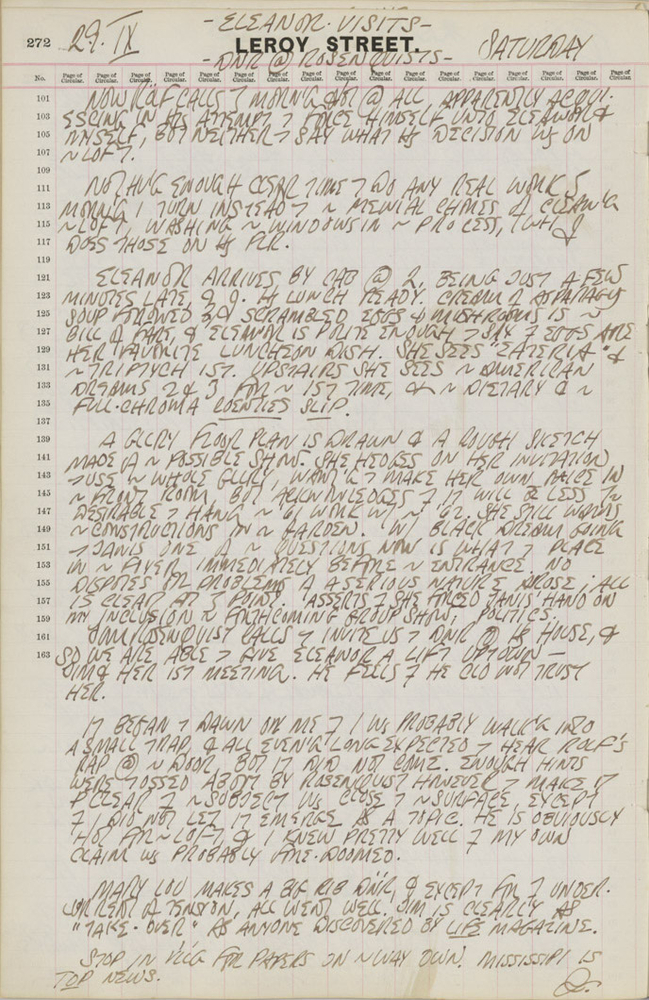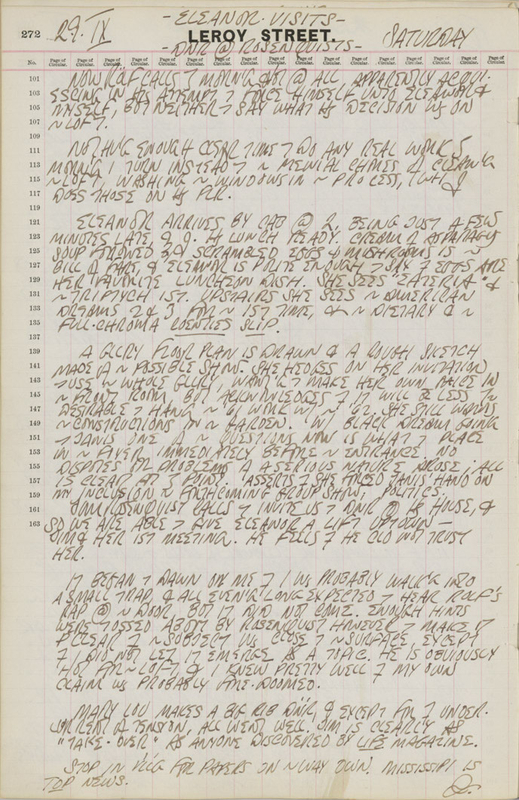
Robert Indiana kept a series of illustrated journals during the late 1950s and 1960s, in which he discusses the development of his work as well as his daily life on Coenties Slip.
In his journal entry for September 29, 1962, Indiana records a morning call from gallerist Rolf Nelson, and cleaning the windows of his loft before the arrival of Eleanor Ward for lunch. Indiana's first solo show was scheduled to open at Ward's Stable Gallery on October 16, 1962. After lunch he notes that Ward saw his paintings The Eateria and The Melville Triptych, followed by The Black Diamond American Dream #2, The Red Diamond American Dream #3, and Coenties Slip, which were upstairs.
Indiana writes: "A gallery floor plan is drawn and a rough sketch made of [the] possible show. She hedges on her invitation [to] use [the] whole gallery, wanting [to] make her own office in [the] front room, but acknowledges [that] it will be less [than] desirable [to] hang [the] '61 works with [the] '62. She still wants [the] constructions in [the] garden. With Black Dream going [to] Janis one of [the] questions now is what [to] place in [the] foyer immediately before [the] entrance. No disputes or problems of a serious nature arose; all is clear at [this] point." He also records that Ward told him that she was responsible for Sydney Janis including him in the corming show at his gallery (International Exhibition of the New Realists).
Indiana then writes that James Rosenquist invited them to dinner, so they were able to give Ward a ride uptown, with Rosenquist remarking about Ward that "he could not trust her." Regarding the dinner he notes that there was an "undercurrent of tension" regarding what Nelson, who was moving, was planning to do with his loft, but that all went well, and that "Jim is clearly as 'take-over' as anyone discovered by Life Magazine" (a reference to an article, "The Take-Over Generation," published in the magazine's September 14, 1962, issue).
Indiana frequently referenced current events in his journal. Here, "Mississippi is top news," refers to James Meredith's admission to the University of Mississippi, which had previously been segregated. This led to the Ole Miss riot of 1962, and the subsequent federal crackdown, a major turning point in the civil rights movement which resulted in the desegregation of the university—the first integration of any public educational facility in Mississippi.