Robert Indiana kept a series of illustrated journals during the late 1950s and 1960s, in which he discusses the development of his work as well as his daily life on Coenties Slip.
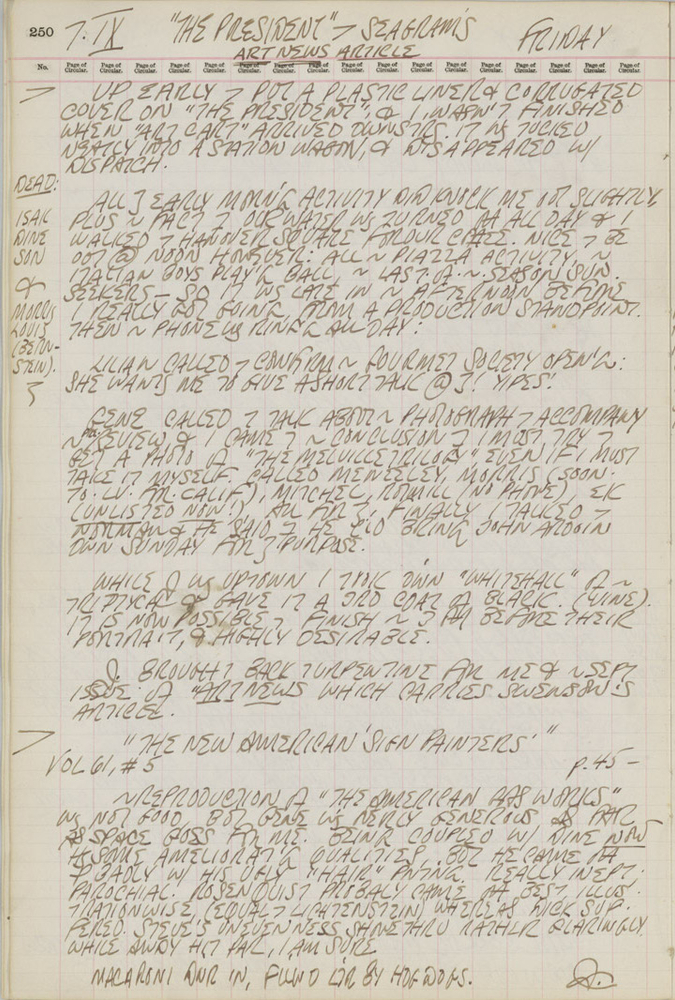
In his journal entry for September 7, 1962, Indiana records being up early to prepare "The President" (A Divorced Man Has Never Been the President) to be taken to the Seagram Building, putting a plastic liner and corrugated cover on it before it was picked up by a company called Art Cart. He writes that he went on a long walk after, so it was late in the afternoon before he really got going, "from a production standpoint," and then the phone was ringing all day.
The first call was from Lilian Ross, who confirmed the opening at the Gourmet Society (in which Indiana's work would be exhibited), and that she wanted him to give a short talk. The second call he records was from art critic Gene Swenson, to talk about a photograph for his "pre-review" (of his solo show at the Stable Gallery, to be published in the October issue of ARTnews). Indiana writes that he decided he must try to get a photo of "The Melville Trilogy" (renamed The Melville Triptych), and that he called various people and finally his friend Norman said he'd bring John Ardoin down Sunday to photograph the painting. He then notes that he gave the "Whitehall" canvas of the triptych a third coat of black, and that it was now possible, and highly desirable, to finish the three canvases before having the work photographed.
Indiana also writes that J. (his partner, fashion designer John Kloss) brought back turpentine for him as well as the September issue of ARTnews, which included Swenson's article "The New American 'Sign Painters'." Regarding the article he writes: "[The] reproduction of “The American Gas Works' was not good, but Gene was overly generous as far as space goes for me. Being coupled with Dine now has some ameliorating qualities, but he came off v[ery] badly with his ugly 'Hair' painting. Really inept-parochial. Rosenquist probably came off best illustrationwise, (equal [to] Lichtenstein), whereas Dick suffered. Steve’s unevenness shone through rather glaringly while Andy hit par, I am sure."